.jpg?format=pjpeg&width=1600&quality=75&auto=webp)
If you are early in the design process, the best first step is to share the application, target performance requirements, and any drawings or CAD files you already have. That gives the team enough context to determine whether a bonded manifold is the right solution and what information may still be needed. Projects with clear requirements move faster and are easier to evaluate accurately. If the application is not yet fully defined, that can still be a useful starting point for discussion.

Regarding Project Fit
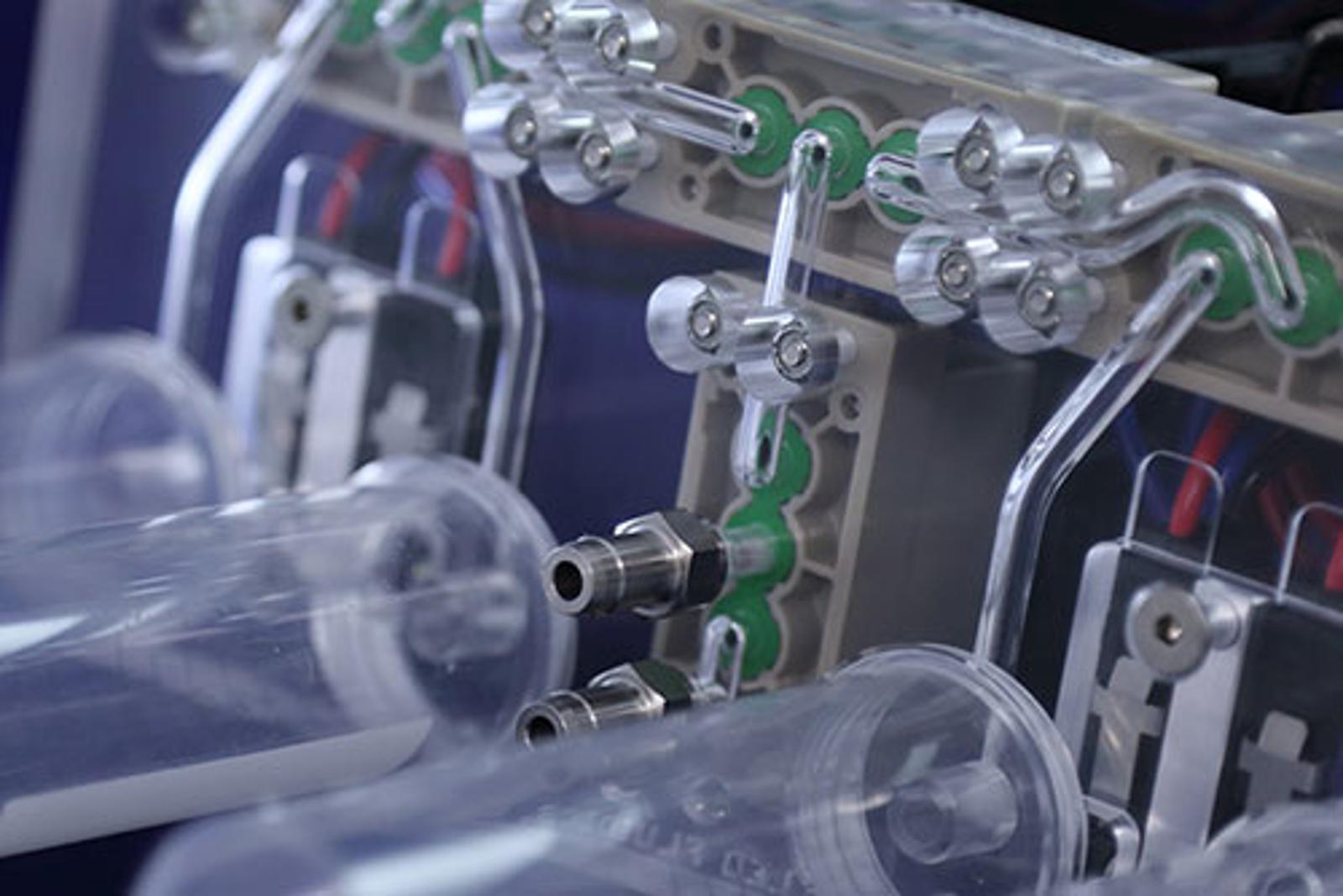
A bonded manifold is a precision fluidic component made by joining two or more machined plastic layers into a single part with internal channels. It is well suited to designs that require compact fluid routing, integrated pathways, or internal geometry that cannot be achieved in a single machined block.
Bonded manifolds are especially useful when engineers need to reduce device size while consolidating multiple functions into one component. Features such as channel bends, overlapping channels, and intricate internal routing often make this process the right choice. If your program requires a custom engineered solution rather than an off-the-shelf part, a bonded manifold may be appropriate.
Design & Engineering
To quote accurately, we typically need a drawing or CAD file, the application, expected volume, target timeline, and any key performance requirements. Material preferences, expected environmental operating conditions, fluid compatibility, and inspection or validation needs are also helpful. If you already know whether the part is for prototype, pilot, or production use, that helps us recommend the right approach. The more complete the project information, the faster we can determine feasibility and prepare a useful and accurate quote.
Performance & Validation
Pressure capability depends on the design itself, material choice, geometry, bond quality, and overall application requirements. There is no single pressure rating that applies to every bonded manifold because performance can vary significantly from one design to another. We have successfully run manifolds with pressures around 500 psi inside the channels but this is not a standard benchmark and should not be treated as a universal limit.
If pressure is a significant requirement, it should be identified early so we can review the
design accordingly.
Quoting & Lead Time
Lead time depends on part complexity, material selection, volume, and whether the project is for prototype or production. Simpler projects may move faster (sometimes in as little as 4 weeks, depending on volume and design complexity), while more complex multilayer designs or those with specialized requirements will naturally take longer. If you have a target launch date, sharing it early helps us assess feasibility and timing. The most accurate lead time can be confirmed once we review the project scope.
Manufacturing & Support
Inspection and documentation options depend on the needs of the application and the level of traceability required. Some projects may only need standard quality verification, while others require more detailed records, inspection data, or support for regulated environments. If your component will be used in a system-essential application, it is best to identify those applications to setup documentation needs early. That allows the review process to account for them from the beginning.