.jpg?format=pjpeg&width=1600&quality=75&auto=webp)
HOW MEDICAL & RESEARCH ARE USING PLASTIC MANIFOLDS
Updated June 25, 2026
Since plastic fabrication methods and technology have been improving over several years, many industries are increasingly using bonded plastic manifolds to replace other legacy materials as designers continue to recognize their inherent value. When built with arrays of different valves, sensors, and connectors, complex manifolds can function very well in a variety of applications. Those systems that have functions to perform pneumatic control, reagent mixing, and flow and bacteria analysis (among several others) use plastic manifolds to get the job done efficiently and effectively.
Bonded manifolds are uniquely capable of meeting the precise requirements of highly regulated applications, providing tight control of fluidic flow within a system. With their capability to integrate many system components directly into a manifold (including pumps, flow sensors, valves, and connectors), bonded plastic manifolds reduce the number of discrete parts and potential leak points in an instrument.
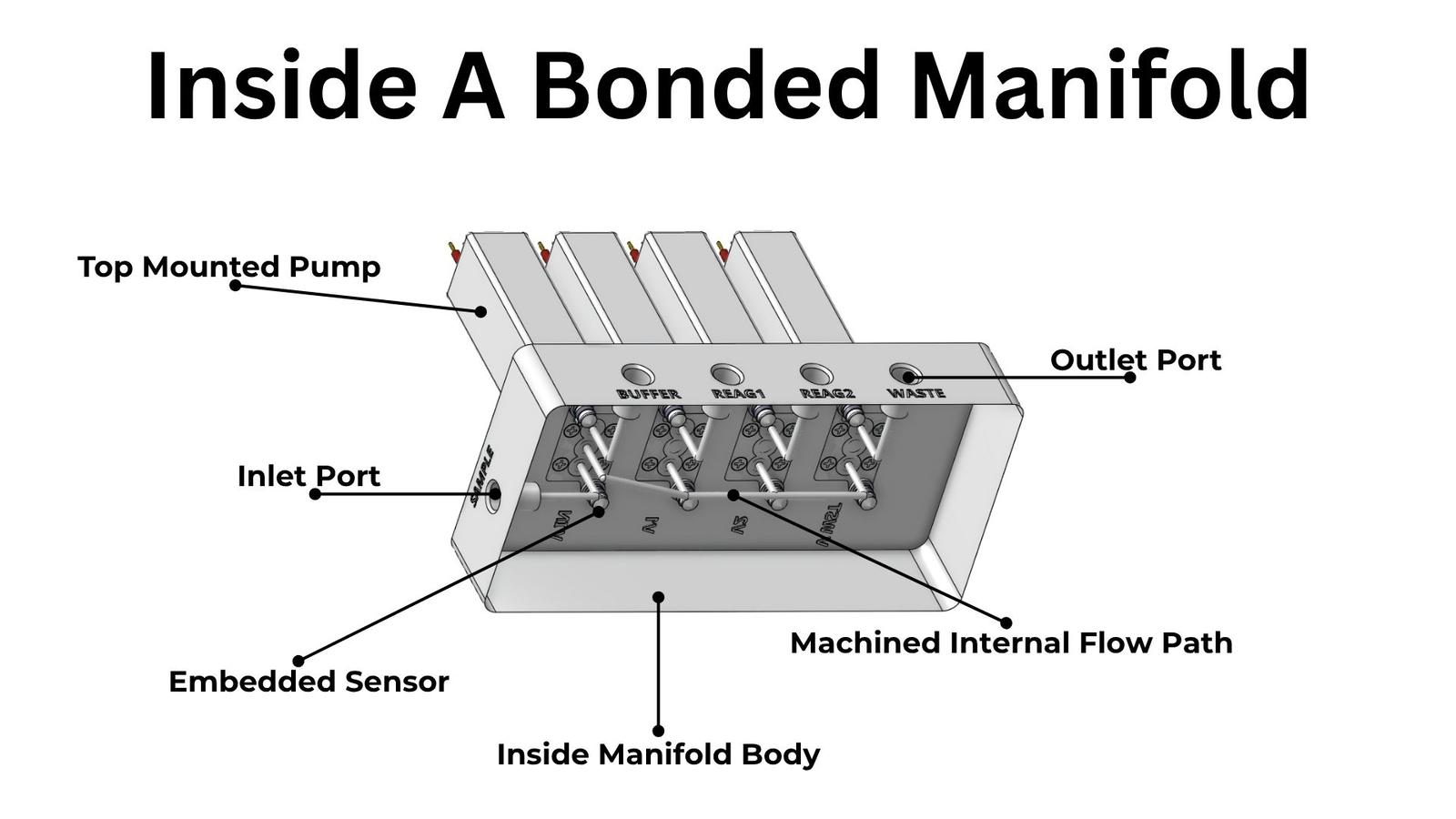
Here, we break down why and how these highly regulated industries are using custom plastic manifolds to advance technology, improve patient quality of life, and help save lives.
BENEFITS OF BONDED PLASTIC MANIFOLDS
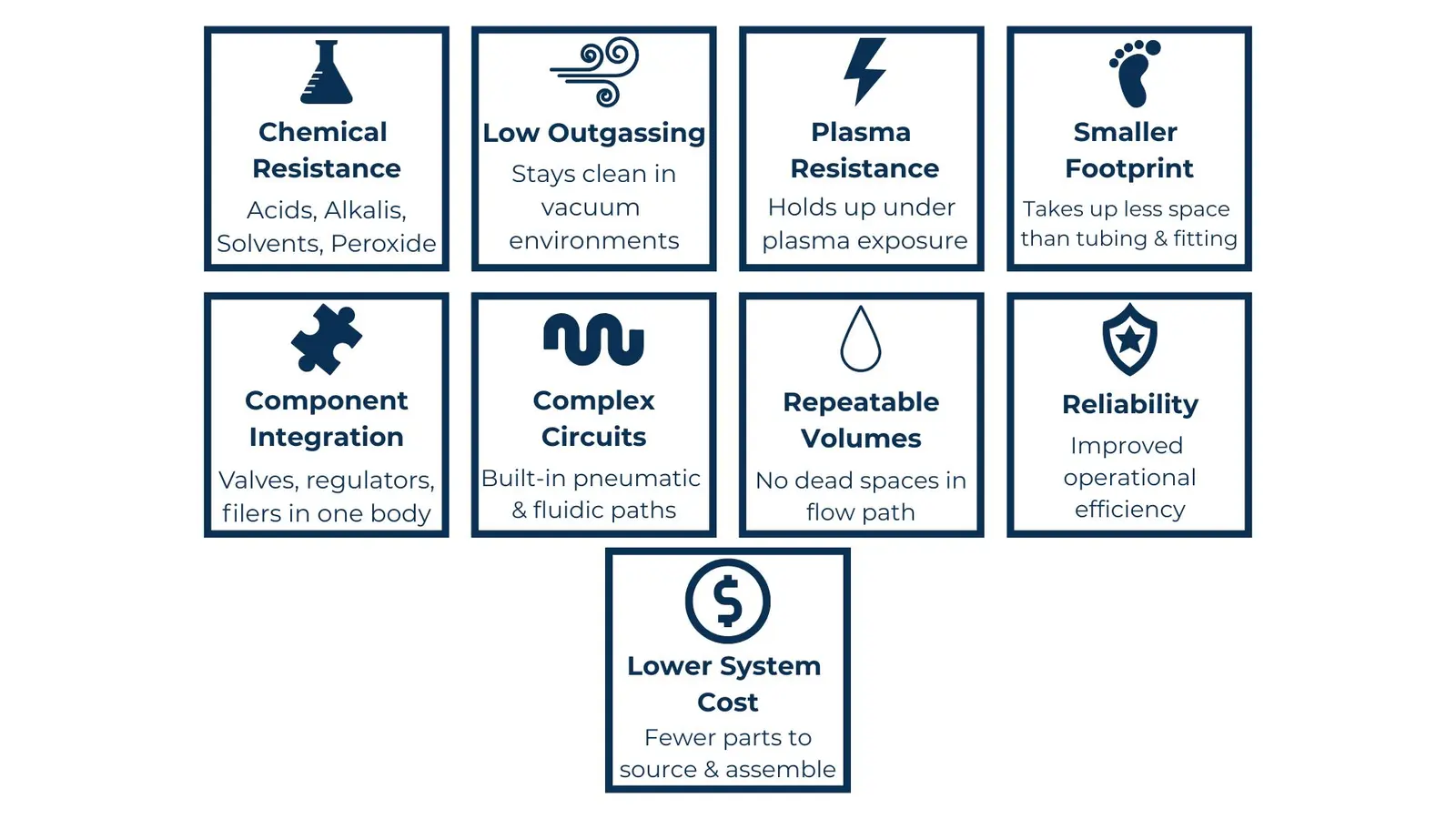
• Depending on the plastic used, they can have excellent chemical resistance to acids, alkalis, and solvents (to name a few).
• Minimal outgassing in a vacuum, helping maintain a sterile or contamination controlled environment.
• Good plasma resistance.
• Reduced overall footprint and weight compared to tubing-and-fitting assemblies.
• Integration of multiple components including fittings, pressure regulators, valves, restrictors, and filters.
• Incorporation of complex pneumatic and/or fluidic circuits directly into the manifold body.
• Maintained, repeatable fluidic volumes between components.
• Elimination of dead spaces within the fluidic pathway.
• Improved reliability and operational efficiency. • Lower overall system cost through part consolidation
WHERE BONDED MANIFOLDS ARE USED

Life Science Applications
Plastic manifolds are well suited to the precise requirements of life science instrumentation. Cell counters, IVD (in vitro diagnostic) instruments, and gene sequencers need intense precision to give the most accurate data possible. Devices like these use plastic manifolds due to plastics’ adaptable manufacturability, optical clarity, chemical resistance, and low autofluorescence. Plastics such as acrylic, COC/COP, polycarbonate, and ULTEM offer these qualities that meet those design needs, including optical detection and fluorescence-based assays.
This need for precision fluid handling is only growing as the field advances. For example, single-cell analysis platforms depend on manifolds that can route nanoliter-to-microliter volumes with minimal dead volume and cross-contamination. Even small inconsistencies in fluid delivery can skew downstream sequencing or expression data. Similarly, the expansion of cell and gene therapy manufacturing has driven demand for closed, single-use fluid pathways. Plastic manifolds support this shift by enabling sterile, disposable circuits that reduce cleaning validation burdens and cross-batch contamination risk compared to reusable metal hardware.
Next-generation sequencing (NGS) instruments, digital PCR systems, and microfluidic organ-on-a-chip platforms also benefit from manifolds engineered with tighter channel tolerances and increasingly miniaturized geometries. This reflects the broader industry trend toward lab automation and high-throughput, low-reagent-volume workflows. Life science labs continue to push toward more compact benchtop instruments and point-of care diagnostics but still need to meet needs for optical clarity and chemical compatibility. This is why materials like COC/COP and acrylic make plastic manifolds a natural fit for emerging detection methods that use fluorescence- and chemiluminescence-based assays used in next-generation diagnostic platforms.
Medical Applications
Multilayer manifolds have become a prime solution for designers seeking smaller, more portable, and lower maintenance medical devices. Their more compact size provides precise control of fluidic system management within integral medical systems. As a result, medical personnel commonly use such manifolds as part of a broader system typically found in applications like lab accessories, patient monitoring devices, diagnostic instruments, and many other devices.
Much like what Life Sciences is experiencing, the trend toward smaller and smarter devices continues to accelerate as medical technology delegates care out of centralized labs and hospitals and more control to the patient. Home-based and wearable devices (such as portable dialysis, infusion, and continuous monitoring systems) depend on compact, lightweight manifolds that integrate pumps, valves, and sensors into a single and patient-manageable low-profile assembly. Combined with smart technology, these devices have now become more reliable, easier to use, and more tolerant of less controlled environments than a hospital setting. Point-of-care testing platforms have gained these qualities as well as they similarly rely on such manifolds engineered for single-use with minimal reagent volumes and rapid, repeatable fluidic performance. With an aging population, these wearables are expanding rapidly to support faster diagnosis and decentralized care.
Within the hospital, robotic and minimally invasive surgical systems have also experienced growth where manifolds help manage precise insufflation, irrigation, and suction in increasingly compact instrument housings. As personalized and cell-based therapies move further into clinical practice, medical device manufacturers are relying on plastic manifolds to build closed and sterile fluid pathways. These support patient-specific dosing and reduce contamination risk, an increasingly more central requirement as treatments shift from one-size-fits-all therapeutics toward individualized care.
Research Applications
Precise, reliable plastic machined parts and manifolds help researchers run experiments as cost-effectively as possible. Research often requires costly reagents and other working fluids. Bonded plastic manifolds and machined plastic parts help researchers minimize the quantities of liquid needed per test. Common uses include DNA sequencing, environmental test devices, diagnostic instrumentation, and food quality control testing.
A growing number of research and development teams are turning to automation and miniaturization to keep pace with increasing experimental throughput demands. Here is where plastic manifolds have become central to that shift. In drug discovery and synthetic biology, high-throughput screening platforms are used heavily and depend on manifolds that can reliably distribute reagents across hundreds or thousands of microwells with minimal variance. Here, inconsistent fluid delivery can directly undermine the statistical validity of screening results. Similarly, the growth of AI- and machine learning driven "self-driving lab" platforms run iterative, automated experiment cycles with little human intervention. There is little room for error. They often rely on manifolds engineered for long-term repeatability and minimal maintenance, since these systems are designed to operate continuously over extended periods without much downtime needed for maintenance.
Emerging fields such as synthetic biology, mRNA and lipid nanoparticle formulation research, and microbiome studies demand manifolds that can handle increasingly sensitive and varied chemistries without contaminating samples or interfering with results. As research labs continue to prioritize reproducibility, lower reagent costs, and faster iteration cycles, the precision and material versatility of plastic manifolds position them as a key enabling technology for next-generation R&D workflows.
Controlled Fluidics manufactures plastic components and bonded manifolds for companies worldwide in research, life sciences, and medical devices. Our engineering team works with a wide range of plastic materials suited to demanding applications. We can work with materials that are largely nonreactive and, in many cases, optically clear and deliver reliable, high-quality solutions for every project. If you’re evaluating a design or need some guidance, our engineers can help you select the best plastic for your unique application.
REACH OUT TO US