Machined Plastics
Plastics
Machined Plastic Parts Materials ABS Plastic for Machined Parts & Prototypes Acetal & Delrin MachiningAcrylic Plastic Materials & MachiningCOC/COP Plastic Materials & MachiningCPVC Plastic Material & MachiningCTFE/KEL-F Plastic Material & MachiningDelrin AF Plastic Material & Machining ECTFE/Halar Plastic Material & Machining Fluorosint® 500 and 207 Plastic Materials & MachiningHDPE Plastic Material & MachiningLDPE Plastic Material & MachiningNoryl® Plastic Material & MachiningNylatron GS: Self Lubricating Nylon for Precision MachiningNylon 6/6 Material & Machining PBT Plastic Material & MachiningPEEK Plastic Material & Machining PES (Radel A) Plastic Material & MachiningPlastic Machining With PETPhenolics/G10 Plastic Machining Polycarbonate Plastic & MachiningPolypropylene Plastic Material & MachiningPolysulfone Plastic Matetial & MachiningPPS Plastic Material & MachiningPVC Plastic & Machining PVDF Plastic Material & MachiningRadel® Plastic Material & MachiningRexolite® Plastic Material & Machining Tecadur Plastic Material & MachiningTeflon® Plastic Machining (PTFE) | Controlled FluidicsTorlon PlasticMaterial & MachiningUHMW Plastic Materials & MachiningUltem® (PEI) Plastic Material & MachiningVespel® Plastic MachiningPOLYMER OPTIONS
cf-logo.png

HOW IT'S ALL CONNECTED

In this section, we will review the different components that manifolds use to enhance function and purpose. Each caters to a unique set of challenges and works to optimize the entire manifold for best operational efficiency. Additionally, we highlight integration opportunities with complementary precision fluid handling solutions from  Thomas Pumps and TriContinent, sibling companies within our  Ingersoll Rand Life Sciences portfolio that offer proven technologies for seamless manifold system integration.

IMPORTANT COMPONENT INTEGRATION TERMS

Here are a few key terms that describe important characteristics of media isolation valves:

Dead volume: The volume inside the valve that cannot be flushed during normal operations. Minimizing or eliminating dead volume is essential in applications where cross-contamination is an issue, such as drawing diagnostic samples from several patients.

Internal Volume: The volume trapped inside the valve assembly when the valve is closed.

Swept volume: The volume of the flow path within the valve assembly. A streamlined flow path where swept volume is equal to internal volume means zero dead volume.

Wetted materials: Any material that contacts the media flowing through the valve. Selecting appropriate materials that contact the media flowing through the valve ensures compatibility and longevity.


KEY COMPONENTS FOR MANIFOLD ASSEMBLY: MOUNTED VALVES

Isolation Valve Basics

Isolation valves separate the activation mechanisms from the moving media. They can be configured as simple 2-way devices or as 3-port selector/diverters. Engineers typically use these in applications where they need a simple on/off function or diversion of liquid flow rather than the ability to gradually modulate flow.

The two main types of media isolation valves are the rocker and the diaphragm varieties. Both have their own unique set of advantages and fit particular purposes. Keep your product in mind if electing these types of valves for your manifold as we explain further.

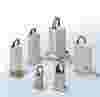
Isolation Valve Basics.jpg

Rocker Style Isolation Valves

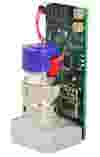
A rocker isolation valve is a solenoid operated device that uses a pivoting rocker mechanism to seal the valve seat and isolates the flow path. Rocker valves can be configured as simple 2-way way devices or as multi-port selectors/diverters.

Rocker valves are generally smaller and more compact than diaphragm valves, making them well suited for applications with space limitations and manifold mounting. Other benefits include low internal volumes and fast actuation times along with relatively low purchasing costs. Due to these reasons, rockers have become a standard for bonded manifold applications. Some provide a full range of orifice/valve sizes with standard and optional features like built-in power saving features, LEDs, plug-in electrical connectors, and more. We recommend that you explore your options further from any of the several global suppliers to ensure that your product and the purpose match seamlessly. 


Integration Note: Valve-Pump Coordination

When pairing isolation valves with precision dispensing systems, the valve characteristics become imperative. TriContinent’s C-Series and CX-Series syringe pumps achieve resolutions up to 384,000 steps per full stroke, enabling precise micro-volume delivery. Rocker valves with minimal dead volume complement the pump’s high-resolution dispensing, ensuring that each micro-volume increment reaches its intended destination without wastage or cross-contamination. This is particularly important in diagnostic and life science applications where sample integrity is paramount.


Diaphragm & Seal Materials

While fluid contact is isolated from the solenoid portion of Rocker style valves, it does come into contact with the valve base and the seals. Most valve suppliers offer their valves with a few different seal materials. These include EPDM (most common), FKM, and Kalrez. These decisions are based on the chemical compatibility of the fluids on these seals, with EPDM being the least expensive option and Kalrez being the most expensive.

Rocker Style Isolation Valves.jpg

Recommendations for Valve Features

For valves, they have some extra features that could prove useful in your manifold’s performance. These include power saving features, connectors, and other elements that can aid in optimal function. Below, we have detailed some of these qualities from our decades of experience in crafting plastic components.

Built-In Power Savings Circuit

If solenoid valves need continuous energy for extended periods of time, use valves with power saving circuits to minimize the amount of heat released by the internal coil.

Plug Connector with Light/Surge Voltage Suppressor

Using the integrated LED and plug-in option for media isolation valves allows electrical harness integration directly to the solenoid valves. This cleans up the assembly and reduces the cost of each valve termination. The LEDs are also a great feature here. So much so that these plug-in connections are our default on all new designs.

Valve With Reverse Mounting Prevention Pin

When designing a manifold with any valve, it is important to consider the valve assembly itself. More specifically, how the manifold design can prevent mounting a valve in a reverse orientation. One simple way we found is to design with valves that have a molded male pin in its base and designing for its clearance in the manifold. This works towards keeping the valve from incorrect installation. We use this new molded male location pin on all new designs we create.

MANIFOLD MOUNT VALVES FOR CDA, GASSES, & VACUUM

Pneumatic Valve Basics 

The poppet and the spool valve take the top two spots for the most common designs for pneumatic control valves, having a few key features that differ it from others. For one, they can mount on top of just about any manifold, and valve manufacturers have standard valve manifold designs for mounting pneumatic valves. Both types available in solenoid and air piloted, these can be placed onto multi-station manifolds as well. When designs call for valve flow to interact with one another, design teams commonly use pneumatic valves on such custom plastic components.

Here are more in-depth details about the valve types used in pneumatics that describe their important characteristics further:

Poppet Valve

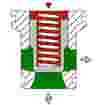
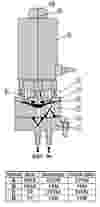
A poppet valve consists of an orifice that opens and closes by raising and lowering a sealing surface onto the orifice. It usually has an internal spring that holds the valve in the closed position. When the spring force is overcome, the sealing surface lifts off the orifice and the valve opens.

Compared to spool valves, poppet valves provide certain advantages and disadvantages which make them better suited for specific applications. We see these used most often in such situations that require one or a combination of the following: precise control, high flow rates, long life, low leak rates, fast response times, or low cost.

Although, we ask that teams consider both the advantages and disadvantages of using such valves within their manifolds.


Advantages 

Disadvantages

  • Higher flow rate in smaller package 
  • Closed crossover
  • Lower friction, longer life
  • Faster response times 
  • Less susceptible to contamination
  • Lower maintenance 
  • Lower purchasing costs 
  • Higher force required to actuate 
  • Back pressure can open valve if supply pressure is removed 


inside of a poppet valve with red and green flow pointers

Spool Valve

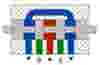
A spool valve A spool valve consists of a shaft with a series of O-rings inside of a barrel. As the shaft moves back and forth, the O-rings shift position to open and close different flow paths, using elastomers to seal between flow paths. Compared to poppet valves, spool valves are better suited for several different applications like vacuum applications, applications which require holding pressure downstream, selector valve applications, and applications which require consistent response time.

With that in mind, spool valves provide certain advantages and disadvantages which teams need to consider as well in their selection.


Advantages

Disadvantages

  • Less force required to actuate
  • Can be used to lock pressure downstream
  • Actuation force unaffected by changes in operating pressure
  • Response times remain constant 
  • More complex flow paths 
  • 4-way functionality 
  • Open crossover 
  • Lower flow rate
  • More seal wear and shorter product life
  • More susceptible to contamination
  • Higher maintenance 
  • Higher purchasing costs

Direct Acting Solenoid Valve: Direct-Acting Solenoid Valves utilize the force generated by the magnetic field of the solenoid to operate the valve. There is no minimum pressure required which makes them also a great choice for low pressure and vacuum applications. When the electrical current is removed, a mechanical spring returns the valve to its original position.

Indirect Acting Solenoid Valve: To conserve power, indirect or pilot assisting solenoid valves utilize air pressure to shift the valve. They often use a miniature 3-way solenoid valve vs a bigger valve solenoid and can operate at very low wattage draw. In doing so it limits the valves minimum operating pressure to approximately 20 psi and therefore not suitable for low pressure or vacuum applications

Spool valve diagram showing red, blue, and green directional flow patterns.

Other Types of Valves

Digital Valves

Digital valves generally have an "on-off" style switch with digital readouts and other capabilities. Several manufacturers market manifold mount valves in sizes as small as 5mm in width and with various flow rates.

Proportional Valves

Unlike digital valves, proportional valves provide air or gas flow control. They vary the output flow based on the current or voltage input to the solenoid.

Rotary Shear Valves: A TriContinent Innovation

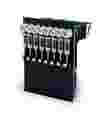
TriContinent has pioneered rotary shear valve technology specifically designed for multi-channel liquid handling applications. These long-life rotary valves completely eliminate the performance limitations commonly associated with solenoid valves, namely clogging, pumping inconsistencies, and leaking. In their  MC6000 multi-channel syringe pump system, rotary shear valves demonstrate lifetime performance up to 24 times that of competing solenoid valve designs. Moreover, there is no maintenance required throughout the valve’s operational life. For device designers integrating multi-channel dispensing capabilities, these rotary valves offer exceptional reliability and zero dead volume characteristics, making them ideal for diagnostics, pharmaceutical, and analytical applications where sample integrity and consistent performance are absolutely necessary

mc6000 multi-channel syringe pump system from TriContinent Scientific
MC6000 multi-channel syringe pump system

ABOUT VALVE LEAKAGE

When choosing a valve, always pay close attention to its advertised leakage rate. Confirm this with your valve manufacturer or supplier as not all publish the leak specs for all components. Many valves have leak rates of 15-100 sccm, which can be fine for many applications in different industries. However, for those in the life science applications, devices often call for low leak valves in the 0.1-1.0 sccm range when possible. to reduce leak rates more effectively, design teams in this industry often utilize on-board pressure or vacuum pumps and storage accumulators in their products. While using pressure or vacuum pumps with storage accumulators is not a “one-size” solution, perhaps it can give an idea to finding a solution that fits your leak rate needs. Valve manufacturers have low-leak valves available that feature large cross sectional O-rings, minimal leak points, and proven poppet designs. All mounting hardware sits outside of the flow path, and no internal parts are threaded during assembly to reduce the possibility of contamination. 

However, with leak rates in mind, this brings about the question of “bubble-tight” valves. When manufacturers say “bubble-tight”, this generally refers to a fully closed valve that does not pass any bubbles when air/nitrogen pressurizes one side of the valve seat and the other side of the seat is submerged in water. Actual test procedures can vary from manufacturer to manufacturer, and as such, there is no formal standard to define “bubble-tight”. Eventually bubbles will leak out at some point in the future whether four seconds pass or thirteen years.

leak-rate-chart.jpg

However, we can refer to the process that tires must pass before market when it comes to leak rates, as an example. In the above chart is the leak rate for such tires. Most are tested to 1 x 10⁻⁵ atm-cc/s, which are commonly seen units from a high vacuum helium leak detector. On an air pressure decay style leak detector, the equivalent leak rate would typically be stated as 0.0002 sccm. If we refer to the chart, we can see that a bubble leak test would take ten minutes before the first bubble would escape to the atmosphere.

These data stand important for several reasons. The chart gives the standard leak rates that valve manufacturers are supposed to have posted alongside their products. This means to give an idea how long a valve will function under optimal circumstances before compromising its integrity and potentially breaking down.

The questions the design team needs to answer would be those about the expected longevity of their product, what kind of seal does both the product and the valve need, and how strict the valve leakage rate needs to be to provide the best operation possible. You may not need a valve with a bubble to leak to atmosphere rate in thirteen years, in which case, this could help in terms of budget. Only plan for what is necessary to meet specs and keep costs controlled.

Design Smarter, Build Stronger

145 pages of engineering insights to improve performance, reduce costs, and speed up production.


Access the Expert Guide & Complete The Form Below

MANIFOLD MOUNT PRESSURE & FLOW CONTROL

Manual Regulators

Often an application requires a regulator to obtain a lower pressure circuit. Manifold mount is a convenient location to control the pressure. There are a few manufacturers that meet the criteria we look for in such regulators; size, accuracy, repeatability, flow, low leakage to atmosphere, manifold sealing surface and cost.

Electronic Proportional Pressure Control

Electronic proportional controllers offer precise, linear digital pressure control within a closed-loop system with ultra high resolution and repeatability. Highly-customizable and available for pressure or flow control of gas applications. It has a great manifold mount interface for your manifold designs

Proportional pressure or vacuum control is often used with fluidic manifolds to precisely control the flow of samples, reagents, and other fluids through the instrument.

Single valve models achieve excellent results in dynamic applications like control of carrier gasses, blanketing gasses or dynamic dispensing applications with the phenomenal high resolution, high accuracy, and repeatability.

Proportional Isolation Valves

There are a limited number of manufacturers of proportional isolation valves for direct manifold mounting. Manifold mounted with zero dead volume, this valve design is ideal in critical applications for liquid and gas delivery, medical and analytical applications requiring ultra fine resolution and excellent repeatability.

Electronic Proportional Pressure Control.jpg
Electronic Proportional Pressure Control Valve

LIQUID PUMPS

Thomas Pumps: Precision Liquid Handling Solutions

Thomas Pumps, a cornerstone of the Ingersoll Rand Life Sciences portfolio, offers a comprehensive range of liquid pumps engineered for demanding OEM applications. With almost 100 years of pump manufacturing expertise, Thomas delivers precision, reliability, and innovation for critical fluid handling requirements.

About Thomas Pumps

Thomas has been meeting OEM pump and compressor needs since 1928, building a legacy of excellence in precision fluid systems. As part of Ingersoll Rand’s Life Sciences division, Thomas provides collaborative engineer-to-engineer support, collaborating in creating customized solutions that transition seamlessly from concept to market-ready products. Their modular design philosophy enables easy customization while maintaining exceptional reliability across healthcare, analytical, environmental, and diagnostics applications.

SR 10 30 DC Stepper motor from Thomas Pumps. All white plastic housing around a small motor with 2 tubes out the top

Liquid Diaphragm Pumps

Liquid diaphragm pumps utilize a flexible diaphragm moved through eccentric motion on the motor shaft. On the downstroke, the medium (or fluid) is drawn into the pump chamber and expelled on the upstroke with internal check valves controlling  the direction of flow. These pumps excel in applications requiring:

  • Gentle Fluid Handling: Ideal for shear-sensitive samples or delicate reagents
  • Low Pulsation: Smooth flow characteristics critical in analytical instruments
  • Chemical Compatibility: Available configurations support diverse media types
  • Compact Integration: Excellent for space-constrained manifold designs

For manifold applications requiring low-volume, high-precision liquid transfer with minimal pulsation, liquid diaphragm pumps integrate seamlessly into custom bonded manifolds or other systems requiring careful fluid transfer. 

Peristaltic Pumps

Advancing fluid transfer technology, Thomas peristaltic pumps (also known as hose or tube pumps) stand out as essential tools for precise, contamination-free fluid transfer. These positive displacement pumps utilize advanced mechanical compression of specialized tubing to create consistent fluid movement without direct contact between the pump mechanism and transferred media. Key advantages of these pumps into devices are: 

  • Zero Contamination Risk: Pump mechanism never contacts the fluid
  • Wide Chemical Compatibility: Works with aggressive or sensitive fluids
  • Minimal Priming Requirements: Ideal for multi-chamber manifolds
  • Quiet Operation: Reduced vibration for sensitive lab environments

For manifold applications requiring low-volume, high-precision liquid transfer with minimal pulsation, liquid diaphragm pumps integrate seamlessly into custom bonded manifolds or other systems requiring careful fluid transfer. 

ETL500 Persitaltic pump with a white plastic housing

Positive Displacement Pumps

Users consider positive displacement pumps as the clear choice when trying to design compact, multi-pump fluidic assemblies. As these can be mounted onto manifolds, this style of pump will often be more precise than a syringe pump without the expense of replacing a syringe. Available in a variety of sizes, they correlate to the volume of fluid that is drawn into the pump and then dispensed.

Considerations when selecting a pump style:

  • Flow Rate
  • Pressure
  • Wetted Materials
  • Dispense Volume
  • Accuracy & Precision Needs 
  • Cycle Lifetime Requirements 

Users can configure displacement pumps easily to optimize the most important aspects of the system’s fluidic requirements. The broad range of pump volumes along with the ceramic piston and pump head options provide many opportunities that can increase a manifold’s function.

Positive Displacement Pumps 1.png
Positive Displacement Pumps 2.png
Positive Displacement Pumps 3.jpg

Liquid Dispense Pump: Solenoid/Diaphragm Style Manifold Mount

Diaphragm solenoid operated pumps are usually derived from a diaphragm-poppet style solenoid valve, where inlet and outlet check valves are added to the valve body. This type of pump utilizes electromagnetism to apply a force to the poppet-diaphragm to positively dispense liquid. The movement of the diaphragm-poppet forces liquid through the one-way (check) valves. The volume dispensed is determined by the stroke of the diaphragm-poppet and the internal geometry of the valve body. Variations in flow rates are achieved by simply varying the frequency input. However, like others mentioned before, these have some advantages and disadvantages to consider. 


Advantages

Disadvantages

  • Available in 5-20 μl configurations for dispense volumes 
  • Extended cycle life
  • inert wetted parts choices 
  • Self-priming 
  • Quiet 
  • Accuracy ±1%-5% of shot(displacement)
  • Fixed displacement per shot
  • Variable shot not available  


Liquid Dispense Pump-Solenoid & Diaphragm Style Manifold Mount.PNG

TriContinent’s High-Precision Syringe Pump Systems

TriContinent specializes in precision syringe pump solutions designed for OEM manufacturers of laboratory instruments, in vitro diagnostics (IVD), and life science equipment. With syringe pump platforms recognized industry-wide for exceptional accuracy, precision, and reliability, TriContinent offers seamless integration opportunities for custom systems requiring micro-volume liquid handling.

About TriContinent

TriContinent has earned the title as trusted partner to leading IVD device manufacturers, life science instrument makers, and biotechnology companies. Their commitment to quality is shown through every aspect of product development from component selection to rigorous testing protocols. As part of Ingersoll Rand’s Life Sciences family, TriContinent collaborates with OEM engineers to deliver customized liquid handling solutions that meet exacting performance standards.


TriContinent Syringe Pump Series

TriContinent offers a modular range of syringe pumps tailored to diverse OEM requirements:


C-Series Syringe Pumps

CX-Series Syringe Pumps

MC6000 Multi-Channel Syringe Pump

AccuPump and BasePump Series

LT Pump (Long-Life, Service-Free)

  • 30 mm Stroke with 192,000 maximum steps
  • Syringe volumes: 50 μL to 12.5 mL
  • Rotary valve options: up to 6-port configurations
  • Full control electronics included
  • Ideal for precision applications requiring high accuracy and repeatability
  • 60 mm Stroke with 384,000 maximum steps (highest resolution in class)
  • Syringe volumes: 50 μL to 25 mL
  • High-resolution linear encoder for fine positional feedback and lost-step detection
  • Rotary valve options: up to 12-port configurations
  • Full control electronics with seamless Cavro® protocol compatibility
  • Superior flow stability (CV of 2.29% at 1 μL/min)
  • Exceptional for ultra-low-volume dispensing and critical analytical applications
  • Available in 4, 6, or 8-channel configurations
  • 30 mm stroke with up to 48,000 steps per stroke
  • Long-life rotary shear valves (eliminate solenoid valve limitations)
  • Integrated bypass capability for complex multi-sample workflows
  • Full quadrature encoder for absolute syringe positioning
  • Ideal for high-throughput diagnostics and automated liquid handling
  • Cost-effective solutions for standard dispensing tasks
  • Syringe volumes: 50 μL to 10 mL
  • Available with or without integrated valve
  • Full or minimal control electronics options
  • Excellent for OEM manufacturers seeking value without sacrificing reliability
  • 30 mm stroke design
  • Syringe volumes: 250 μL to 5 mL
  • No control electronics required (passive operation)
  • Minimal maintenance requirements
  • Ideal for simple, robust manifold application.


AUTO-PIPETTORS

Air displacement pumps and auto-pipettors are used for aspirating and dispensing samples with zero carryover. They are a great choice for benchtop instruments that work with disposable tips. Many customize these further for modular designs that accommodate a wide variety of pipette tips, tip adaptors, liquid level sensors, and pneumatic valves.

Additionally, their compact and lightweight nature allow them to mount directly on most small robotic workstations. This, in turn, makes auto-pipettors suitable for OEM instruments and production line operation.

DESIGN INTEGRATION WITH THOMAS & TRICONTINENT

When designing complete fluidic systems for diagnostic, analytical, or life science applications, consider these integration principles:

Manifold-Pump Compatibility

  1. Flow Path Optimization: Route TriContinent syringe pump discharge through bonded manifold channels to reach multiple downstream destinations with minimal dead volume.
  2. Pressure Considerations: Verify that manifold bonding techniques and material selections support pump discharge pressures; most TriContinent pumps operate in the 0-50 psi range for diagnostic applications.
  3. Electrical Integration: Design manifold mounting surfaces to accommodate TriContinent pump connectors (USB, RS232, RS485, or CAN) and solenoid valve plug connectors with LED status indicators.
  4. Modular Configuration: Leverage TriContinent’s flexible syringe and valve options to create adaptable manifold solutions; multi-channel designs (MC6000) enable single-manifold systems to handle complex multi-reagent protocols.

Thomas Pump Integration

  1. Diaphragm Pump Placement: Thomas liquid diaphragm pumps mount vertically or horizontally; design manifold inlet ports to accommodate pump outlet check-valve connections without dead volume extension.
  2. Peristaltic Pump Considerations: For applications using Thomas peristaltic pumps, design manifold inlet/outlet tubing connections to minimize particle generation and ensure consistent fluid dynamics.
  3. Pressure Regulation: Incorporate Thomas electronic proportional pressure controllers into manifold designs where dynamic pressure adjustment is required for multi-step protocols.

Valve-Pump Coordination

  • Pair high-resolution TriContinent syringe pumps (CX-Series with 384,000 steps) with low-dead-volume rocker valves or rotary shear valves to maximize measurement precision.
  • Ensure valve response times align with pump speed; fast-response isolation valves complement rapid dispensing cycles.
  • Design manifold cavity geometry to minimize dead volume at valve-to pump interfaces.

Material Selection for Compatibility

When bonding manifold plastics around Thomas or TriContinent pump/valve interface, ensure that you do the following:

  • Verify wetted plastic materials (PEEK, PCTFE, UHMWPE) are compatible with application fluids
  • Confirm thermal stability if pump operation generates heat (particularly in continuous-duty applications)
  • Test chemical compatibility of bonding agents with pump seal materials (PTFE, UHMWPE)


Complete manifold assemblies integrate multiple components to deliver reliable, repeatable performance with precision. By selecting valve and pump technologies from Ingersoll Rand Life Sciences partners, designers create robust customized fluidic systems. The modular, engineer-to-engineer support provided by both partners ensures seamless integration from initial concept through production scaling, which enables OEM manufacturers to bring innovative diagnostic and analytical instruments to market with confidence. For detailed specifications, application support, and custom integration assistance, contact Thomas Pumps and TriContinent Scientific directly. Both organizations offer comprehensive technical documentation, compatibility guides, and collaborative engineering resources to optimize your system design.

Stop Wasting Time on Trial-and-Error Designs

Get the strategies that prevent costly mistakes and accelerate development.